Monday, May 18, 2015

Bluebirds

I have been working with the Southern California Bluebird Club to investigate bird nestboxes at a couple of local parks (mostly bluebirds and the occasional Tree Swallows). We have had a few setbacks-- missing eggs, dead nestlings-- which were probably the work of Gopher Snakes, but overall it's been wonderful seeing the nests, eggs, and juveniles as well as adult bluebirds.

Miscellaneous pictures below the fold:

Sunday, May 17, 2015

Baby green herons

They look like some kind of muppet velociraptor:


More of these adorable creatures below the fold:

Friday, May 15, 2015

Hummingbirds in their little nest

I have recently had the opportunity to observe an Anna's Hummingbird nest on an almost-daily basis for a bit over a week, watching the babies grow from tiny nestlings to flying fledgelings. (The image names contain timestamps.)


Saturday, September 27, 2014

Giant Swallowtail

When I found this butterfly, it was completely motionless. Closer inspection, however, showed that it was alive though torpid in the chilly morning. I let it crawl onto my finger, and my mammalian body heat must have given it a jump-start, because it fluttered out of sight.

Thursday, September 4, 2014

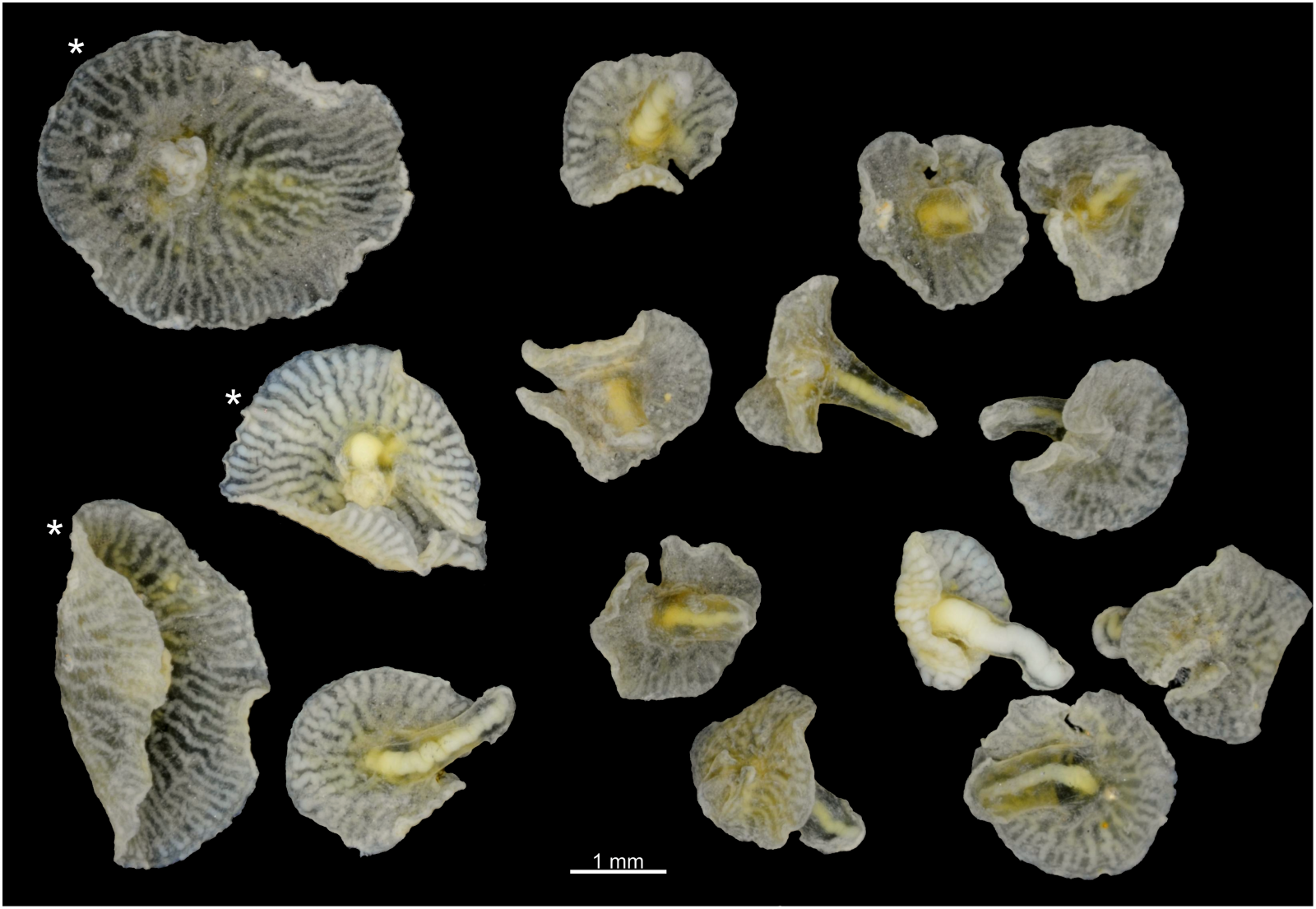
Dendrogramma


A new marine invertebrate, found off the coast of Australia, may be a survivor of Precambrian times:
Though no living animal closely resembles Dendrogramma, at least three fossils bear a striking resemblance. Albumares, Anfesta, and Rugoconites appear to also to have possessed a disk laced with forking, radiating channels.
Those enigmatic organisms have long captivated biologists with mysterious forms that look like whirls, fronds, and shrubs, and it's still debated whether they should be classified as animals. The life-forms are thought to have vanished more than 540 million years ago at the end of the Ediacaran period, just before a time of rapid animal evolution called the Cambrian explosion.
It is possible that Dendrogramma independently evolved a similar structure as a response to the same conditions as the three extinct species, a common phenomenon called convergent evolution.
"There is this most intriguing similarity to certain Ediacaran forms," Conway Morris says. "[But] I think the similarities are exactly that. They are intriguing rather than compelling."
Still, there is a chance that Dendrogramma are Ediacaran descendants, potentially making these animals the first to survive to modern times in recognizable form.
"If this is true," says study co-author Reinhardt Kristensen, an invertebrate zoologist at the University of Copenhagen, "then we have discovered animals which we'd expect to be extinct around 500 million years ago."
More pics from different angles.

Diagram from the original paper

On a related matter, some Ediacaran life-forms-- the earliest multicell animals on Earth-- were fractals.