 |
| Half a coconut |
 |
| With a Red Sea Hare inside! |
 |
| Exterior of the shell (I was careful not to tip the slug out) |
 |
| Another slug |
 |
| Weird seaweed(?) |
 |
| Or possibly a tunicate |
Some fellow beachcombers:
 |
| Godwit |
 |
| Tern |
 |
| Plover |


 |
| Bean clams the green material is not seaweed, but a hydroid that anchors itself onto clams |

 |
| Lots of bean clams |
 |
| Chitons and limpets in a pool |
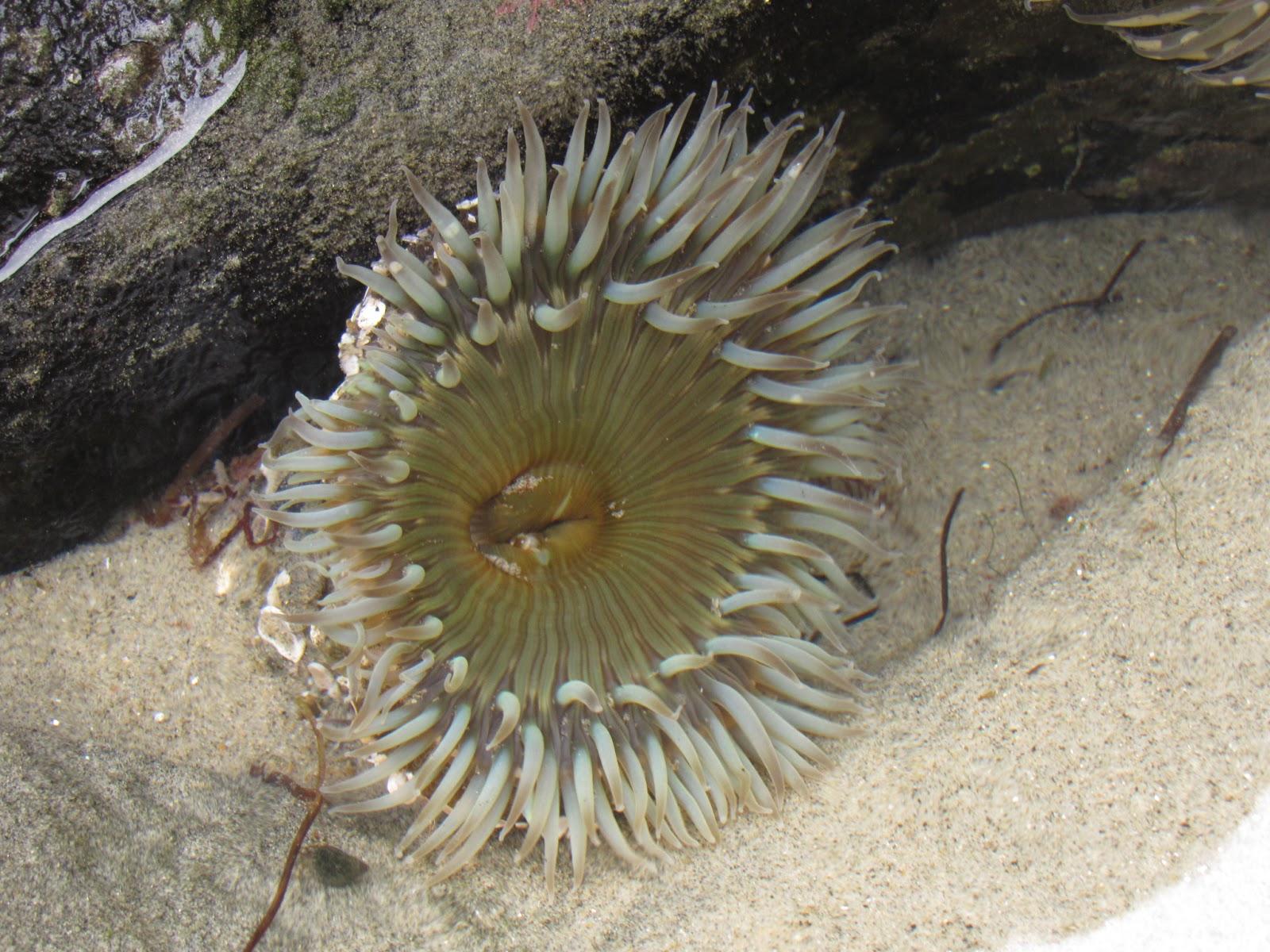 |
| Anemone |
 |
| Royal Tern |
 |
| Crab in a crevice |
 |
| Gradually crumbling cliff face |
 |
| Spotted sandpiper |
 |
| Rock tunnel exposed only when the tide is low |
 |
| Seaweed garden |
 |
| Hermits |
 |
| Whimbrel |
 |
| Sunset |

 |
| Fishing |

 |
| Tentacle tug-a-war |
 |
| Stretchy |
 |
| "I'm keeping an eye on you, land apes." |


Scientists have discovered how two marine creatures are able to rapidly "switch" their colours - from transparent to reddish brown.From BBC News.
The species, an octopus and a squid, use their adaptable camouflage to cope with changing light conditions in the deep ocean...
The animals' skins contain light-sensitive cells called chromatophores, which contain pigments. When these cells detected the blue light of a bioluminescent predator, they immediately expanded, "dyeing" the animal a deep brown colour.
Dr Zylinski said the this dramatic colour change showed just how important camouflage was "in a habitat where there is nowhere to hide".
Neither transparency nor pigmentation is a complete solution to the hunting strategies used by predators in the deep ocean, she explained.
"By switching between these two forms, these cephalopods are able to optimise their camouflage in response to the optical conditions at that moment in time."


