Several 230-million-year-old teeth and egg capsules uncovered at a fossil site in southwestern Kyrgyzstan suggest hundreds of young sharks once congregated in a shallow lake, a new study says.Image (showing a beautiful fossil egg case) and information from National Geographic.
Called hybodontids, the animals were likely bottom feeders, like modern-day nurse sharks.
Mothers would've attached their eggs to horsetails and other marshy plants along the lakeshore. Once born, the Triassic-era babies would've had their pick from a rich food supply of tiny invertebrates, while dense vegetation offered protection from predators.
Saturday, September 10, 2011
Lake sharks of Triassic Kyrgyzstan
Thursday, September 8, 2011
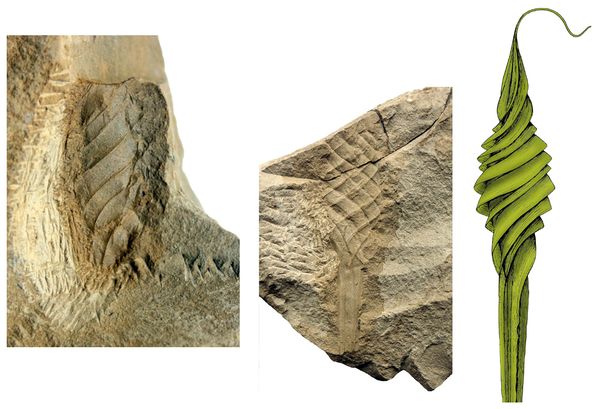
Eoandromeda octobrachiata
Near the roots of the tree of life, we find a living spiral:
A 580-million-year-old fossil is casting doubt on the established tree of animal life. The invertebrate, named Eoandromeda octobrachiata because its body plan resembles the spiral galaxy Andromeda, suggests that the earliest branches in the tree need to be reordered, say the authors of study in Evolution and Development.From Nature, via The Book of Barely Imagined Beings.
The researchers, led by paleontologist Feng Tang of the Chinese Academy of Geological Sciences in Beijing, believe that Eoandromeda is the ancient ancestor of modern ocean dwellers known as comb jellies — gelatinous creatures similar to jellyfish, but rounder and with eight rows of iridescent paddles along their sides. If they are right, it would be the oldest known fossil of a comb jelly. And that would support a rewrite of the animal tree.
Tuesday, September 6, 2011
Ammolite
This colorful, rare gemstone comes from the fossil shells of prehistoric ammonites. Sometimes there are found whole shells composed of ammolite.
Monday, September 5, 2011
"Feathers of Humming Bird, Brittle Star Fish, Fossil Tooth of Shark"
These slides have cover slips of thin glass, which was very expensive and difficult to produce before the 1840s—early mounters more often used sheets of mica, which was far from transparent. The use of Canada balsam sap (which preserves structures and eliminates air and water from samples) as a mounting medium also vastly improved the view.From a SEED Magazine slideshow of Victorian microscope slides. Those shown above are from the collection of Howard Lynk, who has many more; the arranged slides of diatoms and spicules are quite lovely.
Saturday, September 3, 2011
Flowery nest
This is the flower-petal nest of Osmia avoseta, a Turkish solitary bee. It is about half an inch long, and holds a single egg; under the petals is a thin layer of mud.
Further information and more pictures at NPR.
Subscribe to:
Posts (Atom)


